Role of Automation in Healthcare: Transforming Clinical Outcomes
Role of automation in healthcare explained. Explore clinical workflow types, personalized care, EHR integration, and risks in functional medicine.

Confusion about automation in healthcare leaves many practitioners hesitant to adopt new tools. For Functional Medicine and Registered Dietitian professionals, advanced automation promises efficiency without sacrificing clinical expertise. Automation in healthcare supports, but never replaces, clinician judgment and patient-centered care. This article clears up the biggest myths, demystifies automation types, and reveals how the right tools free you to focus on complex decisions that matter most to your patients.
Table of Contents
- Automation in Healthcare: Definition and Misconceptions
- Clinical Workflow Automation Types and Applications
- Personalized Patient Care Through AI and Integration
- Compliance, Safety, and Ethical Responsibilities
- Risks, Cost, and Common Implementation Challenges
Key Takeaways
| Point | Details |
|---|---|
| Automation Enhances Clinical Decision-Making | Automation tools support clinicians by handling repetitive tasks, allowing more time for complex clinical reasoning. |
| AI is a Supportive Tool, Not a Replacement | Understanding that AI enhances human expertise rather than replaces it is crucial for effective integration in healthcare. |
| Personalization is Key to Patient Compliance | Effective AI integration allows for tailored protocols that align with individual patient needs, improving engagement and outcomes. |
| Ethical and Legal Responsibilities Remain with Clinicians | Automation does not transfer accountability; clinicians must maintain oversight and ensure compliance with regulations like HIPAA. |
Automation in Healthcare: Definition and Misconceptions
Automation in healthcare means using AI and decision support tools to handle repetitive tasks, improve efficiency, and enhance clinical decision-making. But here's what matters: these tools assist clinicians. They don't replace them.
Many functional medicine and registered dietitian practitioners hear "automation" and picture robots making patient decisions. That's not how it works. Real healthcare automation augments human expertise, freeing you from administrative burden so you focus on complex clinical reasoning.
Common misconceptions about automation include:
- AI makes perfect diagnoses – Decision support systems improve accuracy but require clinician validation
- Systems eliminate human judgment – They support it; your expertise remains irreplaceable
- Automation handles full patient care independently – Technology enhances workflows, not replaces clinical oversight
- Once implemented, systems run themselves – Automation complacency risks grow without vigilant clinician oversight
The reality is simpler. Misconceptions about AI often stem from sci-fi narratives. Good automation in functional medicine practice works like this: the system generates a Bredesen protocol care plan draft, you review and refine it using clinical judgment. The system flags labs outside protocol ranges, you interpret them contextually for that specific patient.
Your role transforms, not disappears. Instead of spending four hours daily writing care plans, you invest that time on nuanced clinical decisions—adjusting protocols based on patient complexity, catching subtle symptom patterns, and building therapeutic relationships.
Automation works best when you understand its boundaries. Systems process information faster than humans. They never replace the pattern recognition that develops from years of clinical experience or the intuition that guides conversation with a struggling patient.
Automation supports clinician decision-making; it never substitutes for professional judgment and clinical expertise in patient care.
Pro tip: When evaluating automation tools for your practice, prioritize platforms that integrate with your existing EHR and require explicit clinician approval before any recommendation reaches a patient—this maintains your authority over the care plan while capturing efficiency gains.
Clinical Workflow Automation Types and Applications
Healthcare automation isn't one-size-fits-all. Different clinical tasks benefit from different automation approaches, and understanding which tool fits where transforms how you practice.
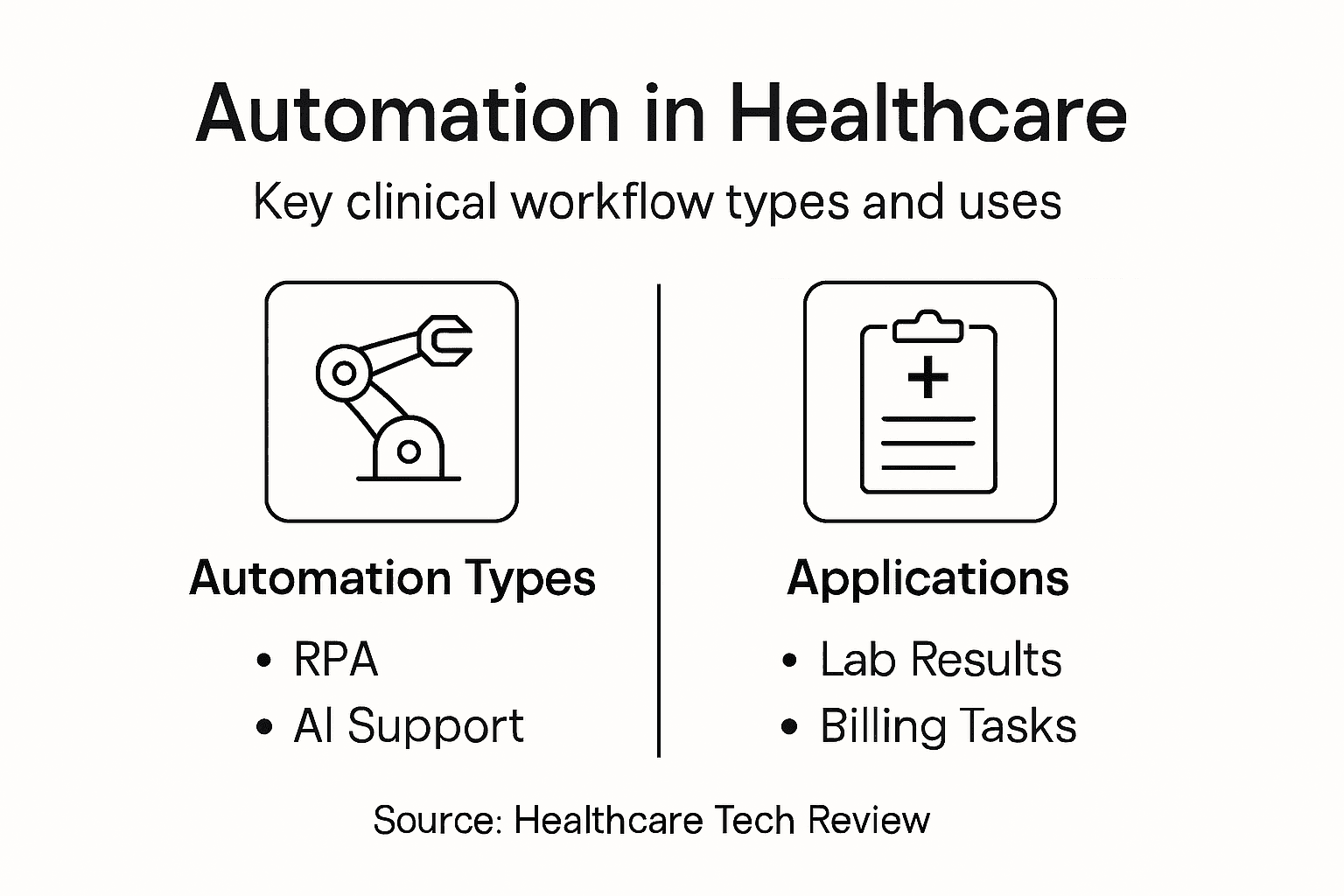
The main automation types that support functional medicine and registered dietitian workflows include:
- Robotic Process Automation (RPA) – Handles repetitive rule-based tasks like processing lab orders, managing billing, or scheduling patient appointments
- AI-driven clinical decision support – Generates protocol-specific recommendations for Bredesen, Shoemaker, or Wahls frameworks based on patient data
- Diagnostic and data automation – Flags abnormal lab values, organizes patient histories, and identifies patterns across time
- Real-time monitoring systems – Alerts you to patient status changes or missing data points in active care plans
Robotic Process Automation in healthcare reduces administrative burden significantly. Instead of manually entering lab results from three different testing labs into your EHR, RPA pulls that data automatically, standardizes formats, and flags outliers. This frees your cognitive energy for interpretation.
In functional medicine practice, automation types like RPA and AI decision support work across patient data management, appointment scheduling, and longitudinal monitoring. You're not replacing your clinical eye—you're multiplying it across more patients simultaneously.
Consider a real workflow: Patient submits labs. System automatically imports results, compares against previous values, cross-references protocol parameters. Within minutes, you review a structured summary highlighting what changed and what matters clinically. Without automation, this takes 30 minutes per patient.

The practical applications matter most. Claims processing, inventory tracking, and billing corrections—all repetitive tasks RPA handles while you focus on patient conversations and clinical reasoning.
Here is a summary of major automation types in healthcare and their primary clinical benefits:
| Automation Type | Main Function | Key Benefit for Clinicians |
|---|---|---|
| Robotic Process Automation | Automates paperwork and scheduling | Saves time on routine admin tasks |
| AI Decision Support Systems | Generates data-driven recommendations | Increases protocol accuracy and consistency |
| Diagnostic/Data Automation | Flags anomalies and organizes records | Improves early issue identification |
| Real-Time Monitoring Systems | Tracks patient vitals automatically | Enables faster clinical response |
Automation handles what's repetitive and rule-based; you handle what requires judgment, intuition, and human connection in patient care.
Pro tip: When implementing automation in your practice, start with your biggest time drain—whether that's appointment scheduling, lab management, or care plan documentation—so you feel the efficiency gain immediately and build team confidence in the system.
Personalized Patient Care Through AI and Integration
Personalization in functional medicine goes beyond adding a patient's name to emails. It means adapting protocols, timing interventions, and adjusting recommendations based on that individual's unique biology, preferences, and life context.
AI integration transforms this from theoretical ideal to practical reality. Systems process thousands of data points—lab histories, symptom patterns, medication interactions, genetic markers—to suggest adjustments specific to each patient rather than generic protocol templates.
Key ways AI enables personalization:
- Adaptive treatment pathways – System learns patient response patterns and adjusts Bredesen or Wahls protocol sequencing based on their progress
- Predictive analytics – Flags which interventions likely work best for patients with similar lab profiles and symptom clusters
- Continuous monitoring integration – Wearable data streams continuously inform care adjustments without requiring patient to remember reporting details
- Shared decision-making support – AI surfaces evidence and outcomes aligned with patient values, not just clinical guidelines
AI-powered clinical decision-making respects individual patient needs while grounding recommendations in evidence. Rather than a one-size-fits-all Bredesen protocol, the system recognizes that your patient with APOE4 genotype and early sleep disturbance needs different timing and intensity than another patient with cognitive concerns but normal genetics.
AI integration enhances patient-centered care by balancing technology with human insight. You bring clinical judgment; AI brings pattern recognition across thousands of similar cases. Together, you create care plans that feel personalized because they actually are.
This matters clinically. Patients follow protocols they understand as tailored to them. Compliance improves. Outcomes improve. You spend less time explaining why a generic approach won't work for their specific situation.
Personalized care means tailoring protocols to the individual patient sitting in front of you, not fitting patients into predetermined boxes.
Pro tip: When integrating AI into personalization, always review the system's reasoning before presenting recommendations to patients—understanding why the system suggested a specific nutrient dose or protocol sequence lets you explain it confidently and adjust based on clinical context.
Compliance, Safety, and Ethical Responsibilities
Automation in healthcare isn't a legal gray area—it's bound by regulations, liability standards, and ethical obligations that protect both patients and practitioners. Understanding these responsibilities matters before you implement any system.
Your primary obligations include:
- Patient data security – Automation systems must comply with HIPAA standards; patient information stays encrypted and access-controlled
- Algorithm transparency – You need to understand how the system reaches recommendations, not just accept outputs blindly
- Bias mitigation – AI trained on skewed datasets can perpetuate healthcare disparities; you're responsible for catching this
- Informed consent – Patients should know when AI influences their care recommendations and how
- Clinical accountability – The final decision and responsibility remain yours, regardless of what automation suggests
Ethical responsibilities in healthcare automation include safeguarding data privacy, ensuring algorithm transparency, and maintaining patient trust. Your automation platform should provide audit trails showing exactly which data informed each recommendation.
Regulatory compliance varies by location. In the United States, HIPAA applies to any system handling protected health information. Some states add stricter requirements around AI use in clinical decision-making. Know your jurisdiction's specific rules before implementation.
Liability remains with you as the clinician. Automation amplifies your clinical reach—it doesn't shield you from responsibility. If a system recommends something harmful and you implement it without questioning the reasoning, that's a liability issue even if the system "made the suggestion."
Bias in automation is real and subtle. If training data came primarily from certain demographics, the system may perform differently—sometimes poorly—for patients outside that group. Audit your system's performance across different patient populations regularly.
Your legal and ethical responsibility for patient outcomes never transfers to the automation system, regardless of how sophisticated it is.
Pro tip: Before implementing any automation platform, request documentation on HIPAA compliance, algorithm methodology, bias testing results, and liability coverage—these aren't optional features, they're baseline requirements for responsible clinical practice.
Risks, Cost, and Common Implementation Challenges
Automation sounds ideal until you face the reality: upfront costs, staff resistance, integration nightmares, and the risk of over-relying on imperfect systems. Understanding these challenges upfront saves you time, money, and frustration.
The main challenges practitioners encounter include:
- Financial barriers – Licensing fees, integration costs, and staff training require significant upfront investment before you see efficiency gains
- Change resistance – Team members accustomed to current workflows often push back on automation, fearing job displacement or added complexity
- Integration complexity – Your automation system must connect with your EHR, billing software, and lab systems; mismatches create data silos
- Automation bias – Over-trusting system recommendations without clinical validation leads to missed nuances and poor patient outcomes
- Vendor lock-in – Switching platforms later becomes expensive and disruptive once workflows depend on a specific system
Common barriers to healthcare automation implementation include financial constraints, technological immaturity, and clinician resistance. Addressing these requires deliberate strategy: phased rollouts reduce cost shock, comprehensive training builds team confidence, and stakeholder engagement from day one prevents silent sabotage.
Costs vary dramatically based on practice size and complexity. Small functional medicine practices might invest $500 to $2,000 monthly for platform subscriptions plus integration and training costs. Larger clinics see economies of scale but also more complex implementation challenges.
The hidden cost is time during transition. Your team will work slower initially as they learn new workflows. Plan for 3 to 6 months of reduced efficiency before automation delivers net gains. This matters psychologically—staff need realistic timelines or frustration kills adoption.
Below is a comparison of common implementation challenges with suggested strategies for overcoming each:
| Challenge | Root Cause | Overcoming Strategy |
|---|---|---|
| Financial Barriers | High initial investment for setup | Phased rollout and return analysis |
| Change Resistance | Staff worry over new systems | Team training and clear communication |
| Integration Complexity | Incompatible software and data silos | Prioritize interoperable solutions |
| Automation Bias | Overtrust in system recommendations | Mandatory review checkpoints |
| Vendor Lock-In | Costly to switch platforms after adoption | Negotiate exit clauses up front |
Automation bias is subtle but serious. When systems suggest something, there's psychological pressure to accept it, especially when you're busy. Combat this by building in mandatory review checkpoints and never letting automation bypass your clinical reasoning.
Implementation success depends more on change management and realistic expectations than on technology features alone.
Pro tip: Before committing to any automation platform, request a 30-day pilot with your actual EHR and patient data, involve your entire team in testing, and set clear metrics for success so you can objectively evaluate whether to proceed full implementation.
Unlock the Power of Automation to Elevate Your Clinical Practice
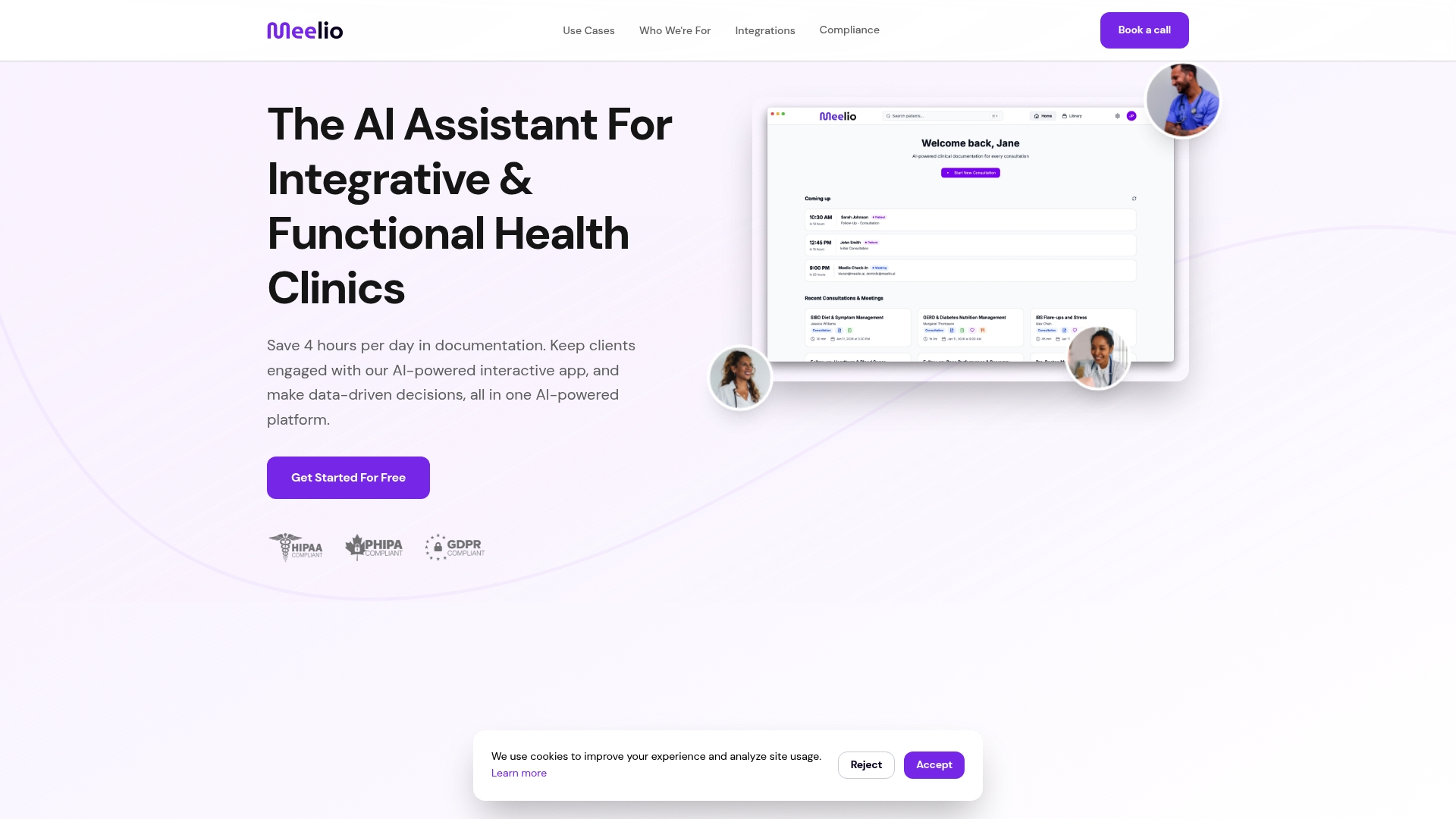
The article highlights critical challenges like excessive administrative burden, the need for personalized protocol-specific recommendations, and the risks of inefficient workflow integration—all common hurdles for functional medicine and integrative health practitioners. If you want to transform hours of manual care plan generation and lab analysis into streamlined, clinically intelligent processes that respect your professional judgment automation is the key. Meelio offers an AI-powered clinical workflow platform designed specifically for complex frameworks like Bredesen Shoemaker and Wahls. Our platform integrates seamlessly with popular EHRs such as Practice Better and Cerbo so you save 4+ hours daily while enhancing care quality.
Experience firsthand how targeted automation supports your clinical decision-making without replacing it. Don’t let excessive administrative tasks keep you from delivering deeply personalized patient care. Visit Meelio and discover a solution that understands your need for protocol-specific clinical intelligence with features like automated care plan generation personalized nutrition recommendations and longitudinal lab analysis. Take control of your clinical workflow today before integration challenges and automation bias hold back your practice’s growth.
Frequently Asked Questions
What is the role of automation in healthcare?
Automation in healthcare involves using AI and decision support tools to handle repetitive tasks, improve efficiency, and assist clinicians in clinical decision-making. It aims to enhance workflows while freeing up clinicians to focus on complex patient care.
How does automation improve clinical outcomes?
Automation improves clinical outcomes by reducing administrative burdens, allowing clinicians to devote more time to nuanced patient care. By streamlining processes like lab management and care plan documentation, automation enables faster and more accurate clinical responses, ultimately improving patient compliance and outcomes.
What are some common misconceptions about healthcare automation?
Common misconceptions include the belief that AI makes perfect diagnoses, that automation eliminates human judgment, and that it can independently manage all aspects of patient care. In reality, automation supports clinicians by augmenting their expertise rather than replacing it.
What types of tasks can be automated in a healthcare setting?
Tasks suitable for automation in healthcare include processing lab orders, managing billing, generating clinical decision support recommendations, flagging abnormal lab values, and tracking patient vitals. These tasks are often repetitive and can be streamlined using automation technologies.