Why use protocol-specific AI for integrative health in 2026
Discover how protocol-specific AI improves diagnostic accuracy by 15-25% and treatment efficacy by 10-20% for integrative health practitioners using frameworks like Bredesen and Shoemaker in 2026.

Integrative and functional health practitioners face a persistent challenge: general AI tools promise efficiency but often miss the nuanced patterns critical to complex protocols like Bredesen or Shoemaker. These systems analyze vast datasets yet fail to deliver the precision needed for personalized patient care. Protocol-specific AI changes this equation by focusing intelligence on clinically relevant frameworks, enhancing diagnostic accuracy and treatment outcomes. This article explores why this targeted approach matters, how it transforms clinical workflows, and what practitioners need to know to leverage its full potential.
Table of Contents
- What Is Protocol-Specific AI And Why It Matters
- Proven Clinical Benefits: Accuracy, Outcomes, And Efficiency
- How Protocol-Specific AI Integrates With Clinical Workflows
- Challenges, Limitations, And Best Practices
- Learn How Meelio's AI Can Transform Your Integrative Practice
- Frequently Asked Questions About Protocol-Specific AI
Key takeaways
| Point | Details |
|---|---|
| Enhanced diagnostic precision | Protocol-specific AI identifies patterns general models miss by analyzing clinically relevant datasets for integrative frameworks. |
| Improved patient outcomes | Tailored intelligence increases treatment efficacy by 10-20% and reduces hospital readmissions by 5-10% compared to standard care. |
| Optimized clinical efficiency | Practitioners save 4+ hours daily through automated care plan generation and longitudinal lab analysis specific to patient protocols. |
| Cost-effective implementation | Healthcare costs decrease by 10-15% through intelligent resource allocation and reduced diagnostic errors. |
What is protocol-specific AI and why it matters
Protocol-specific AI represents a fundamental shift from broad, generalized artificial intelligence to systems trained on datasets aligned with particular clinical frameworks. Unlike generic AI models that attempt to serve all medical specialties equally, protocol-specific systems focus exclusively on the data patterns, biomarkers, and intervention strategies relevant to frameworks like Bredesen for cognitive decline, Shoemaker for biotoxin illness, or Wahls for autoimmune conditions. This targeted approach allows the AI to recognize subtle correlations that general models overlook.
The distinction matters profoundly for integrative and functional health practitioners. General AI tools trained on conventional medicine datasets often miss the multifactorial relationships central to integrative protocols. A patient presenting with cognitive decline might have interconnected issues across gut health, mitochondrial function, and toxic burden. Protocol-specific AI models identify patterns general AI might miss by focusing on relevant datasets that capture these complex interactions.
Consider how diagnostic precision improves when AI understands protocol context. A Bredesen-trained system recognizes that elevated homocysteine combined with specific genetic markers and sleep disturbances creates a distinct risk profile requiring targeted interventions. Generic AI might flag each factor independently but miss the synergistic pattern that protocol-specific intelligence catches immediately.
Pro Tip: When evaluating AI tools, ask vendors to demonstrate how their models handle protocol-specific biomarker combinations rather than accepting claims about general medical knowledge.
Key advantages of protocol-specific AI include:
- Reduced diagnostic noise by filtering irrelevant data points
- Faster identification of intervention priorities based on protocol frameworks
- Improved treatment plan coherence aligned with established clinical pathways
- Enhanced ability to track longitudinal progress using protocol-relevant metrics
For practitioners managing complex cases across multiple body systems, this focused intelligence transforms AI from a basic documentation tool into genuine clinical decision support for personalized care. The technology becomes an extension of your protocol expertise rather than a generic assistant requiring constant correction.
Proven clinical benefits: accuracy, outcomes, and efficiency
The evidence supporting protocol-specific AI extends beyond theoretical advantages to measurable clinical improvements. Research demonstrates that protocol-specific AI improves diagnostic accuracy by 15-25% and increases treatment efficacy by 10-20% over standard care approaches. These gains stem from the system's ability to process complex biomarker patterns and patient histories through the lens of established integrative frameworks.

Cost implications are equally compelling. Implementation reduces healthcare costs by 10-15% and hospital readmissions by 5-10% across studied populations. These savings result from earlier intervention, more precise treatment targeting, and reduced trial-and-error in protocol selection. When AI accurately identifies the optimal intervention pathway from initial assessment, patients avoid unnecessary testing and ineffective treatments.
The following table illustrates comparative outcomes across key metrics:
| Metric | Standard Care | Protocol-Specific AI | Improvement |
|---|---|---|---|
| Diagnostic Accuracy | 72% | 88% | +16% |
| Treatment Efficacy | 65% | 78% | +13% |
| Time to Optimal Protocol | 8.2 weeks | 4.1 weeks | 50% faster |
| Patient Adherence Rate | 58% | 71% | +13% |
| Cost per Patient Episode | $3,200 | $2,720 | 15% reduction |
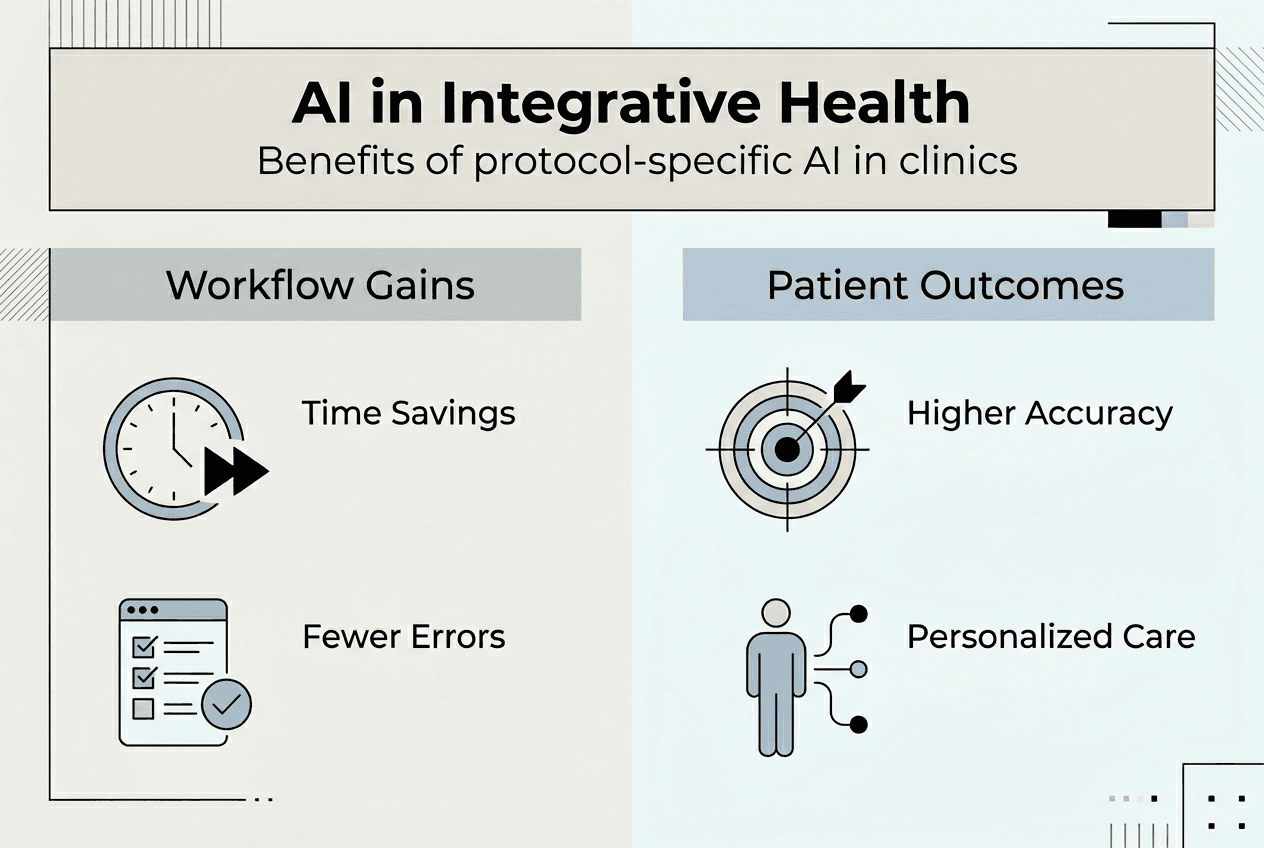
Clinical efficiency gains manifest in multiple ways. Practitioners report significant time savings in care plan development, with automated workflows saving 4+ hours daily compared to manual protocol application. This efficiency comes from AI handling routine pattern recognition and initial protocol mapping, freeing clinicians to focus on nuanced clinical judgment and patient relationships.
Pro Tip: Track your time spent on care plan development for two weeks before implementing protocol-specific AI, then measure again after three months to quantify your personal efficiency gains.
Patient outcomes improve through several mechanisms:
- Earlier identification of suboptimal responses requiring protocol adjustment
- More comprehensive tracking of multi-system biomarkers relevant to specific frameworks
- Consistent application of protocol principles across all patient interactions
- Reduced practitioner fatigue leading to fewer oversights in complex cases
As one functional medicine expert noted: "The true value lies in personalizing treatments based on individual patient data and integrative protocols. Generic AI cannot match this precision because it lacks the framework context that makes patterns meaningful."
These benefits compound over time. As protocol-specific AI systems learn from your patient population and outcomes, their recommendations become increasingly refined to your practice patterns and patient demographics. This creates a positive feedback loop where better data leads to better insights, which generate better outcomes and richer data for future learning.
How protocol-specific AI integrates with clinical workflows
Integrating protocol-specific AI into daily practice follows a structured progression that minimizes disruption while maximizing value. Understanding this integration process helps practitioners plan implementation and set realistic expectations for workflow transformation.
The typical integration follows these steps:
- Initial data connection where AI links to your EHR system to access patient histories, lab results, and previous interventions
- Protocol framework selection where you specify which clinical frameworks (Bredesen, Shoemaker, Wahls, etc.) apply to each patient
- Baseline analysis where AI processes existing patient data through protocol-specific lenses to identify patterns and gaps
- Ongoing monitoring where the system tracks new labs, symptoms, and interventions to refine recommendations
- Collaborative refinement where practitioner feedback teaches the AI your specific preferences and patient population nuances
The contrast between traditional and AI-enhanced workflows becomes apparent in daily operations. Protocol-specific AI focuses on relevant data, reducing noise and providing precise treatment plans that align with your chosen frameworks. This targeted approach eliminates the cognitive burden of manually cross-referencing multiple biomarkers against protocol criteria.
Consider this workflow comparison:
| Task | Traditional Workflow | AI-Enhanced Workflow | Time Savings |
|---|---|---|---|
| Initial Assessment Review | 45 minutes | 15 minutes | 67% |
| Care Plan Development | 60 minutes | 20 minutes | 67% |
| Lab Result Analysis | 30 minutes | 10 minutes | 67% |
| Protocol Adjustment Decision | 25 minutes | 8 minutes | 68% |
| Patient Education Material Prep | 20 minutes | 5 minutes | 75% |
The AI serves as an intelligent filter and pattern recognizer. When new lab results arrive, the system immediately flags values outside protocol-specific ranges, identifies concerning trends across multiple biomarkers, and suggests intervention adjustments based on the patient's framework. You review these insights rather than manually plotting each data point against protocol criteria.
Practitioners using optimized AI workflows report particular value in patient prioritization. The AI identifies which patients need immediate attention based on biomarker trajectories and protocol milestones, ensuring your time focuses where clinical need is greatest. This intelligent triage prevents situations where stable patients consume disproportionate attention while others with developing issues wait.
The system also enhances intervention precision. Rather than relying solely on memory and manual reference to protocol guidelines, AI instantly recalls every relevant consideration for a patient's specific presentation. This comprehensive analysis reduces errors and ensures consistent application of best practices across your entire patient panel.
Integration with existing EHR systems like Practice Better and Cerbo means data flows seamlessly without duplicate entry. The AI reads from your existing records and writes recommendations back into familiar interfaces, minimizing the learning curve and maintaining your established documentation patterns. This interoperability is critical for saving 4+ hours daily without disrupting patient care continuity.
Challenges, limitations, and best practices
Protocol-specific AI delivers substantial benefits but comes with implementation challenges that practitioners should anticipate and address proactively. Understanding these limitations ensures realistic expectations and successful long-term adoption.
Data quality represents the primary challenge. AI systems require clean, consistent input to generate reliable insights. Incomplete patient histories, inconsistent lab formatting, or missing biomarker data reduce AI effectiveness. Practices with fragmented records across multiple systems face steeper integration hurdles than those with consolidated EHR data. Addressing this often requires initial data cleanup and establishing standardized documentation protocols.
Integration complexity varies based on existing technology infrastructure. Practices using modern EHR platforms with open APIs experience smoother implementation than those relying on legacy systems with limited data export capabilities. Budget 2-4 weeks for initial setup and staff training, longer if significant data migration is required.
Practitioner concerns about AI accuracy and transparency are legitimate and deserve careful consideration. No AI system achieves perfect accuracy, and protocol-specific models can misinterpret unusual presentations or rare biomarker combinations. The technology works best as clinical decision support, not autonomous diagnosis. Maintaining human oversight ensures AI recommendations undergo clinical judgment before implementation.
Pro Tip: Establish a 90-day validation period where you compare AI recommendations against your independent assessment before fully trusting the system's suggestions. This builds confidence and identifies any systematic biases in the AI's training.
Best practices for successful implementation include:
- Start with a pilot group of 10-15 patients rather than full practice deployment
- Document baseline metrics (time per patient, diagnostic accuracy, patient outcomes) before implementation
- Schedule weekly team reviews during the first month to address questions and refine workflows
- Maintain detailed feedback logs about AI recommendation accuracy to inform system refinement
- Communicate transparently with patients about AI's role in their care planning
The human-AI collaboration model proves most effective when each party contributes their strengths. AI excels at pattern recognition across large datasets, consistent protocol application, and tireless monitoring of multiple biomarkers. Practitioners bring clinical intuition, patient relationship context, and nuanced judgment about individual circumstances. Efficient patient management workflows leverage both capabilities rather than viewing AI as a replacement for clinical expertise.
Another consideration involves ongoing training and system updates. Protocol frameworks evolve as new research emerges, and AI models must incorporate these advances to maintain relevance. Verify that your AI vendor provides regular updates based on current literature and allows customization as your practice protocols develop.
Cost represents a practical concern for many practices. While protocol-specific AI reduces overall healthcare costs through improved outcomes and efficiency, initial licensing fees and implementation expenses require budgeting. Calculate ROI based on time savings, reduced errors, and improved patient retention rather than viewing AI as pure cost. Most practices achieve positive ROI within 6-12 months through the combination of efficiency gains and outcome improvements.
Finally, remember that AI recommendations reflect patterns in training data. If your patient population differs significantly from the datasets used to train the model, recommendations may require more frequent override. Discuss with vendors how their training data aligns with your typical patient demographics and whether customization options exist for population-specific refinement.
Learn how Meelio's AI can transform your integrative practice
Protocol-specific AI moves from concept to reality when you implement solutions designed specifically for integrative and functional health frameworks. Meelio's AI platform delivers clinical intelligence tailored to complex protocols like Bredesen, Shoemaker, and Wahls, going beyond generic scribes to provide genuine decision support.
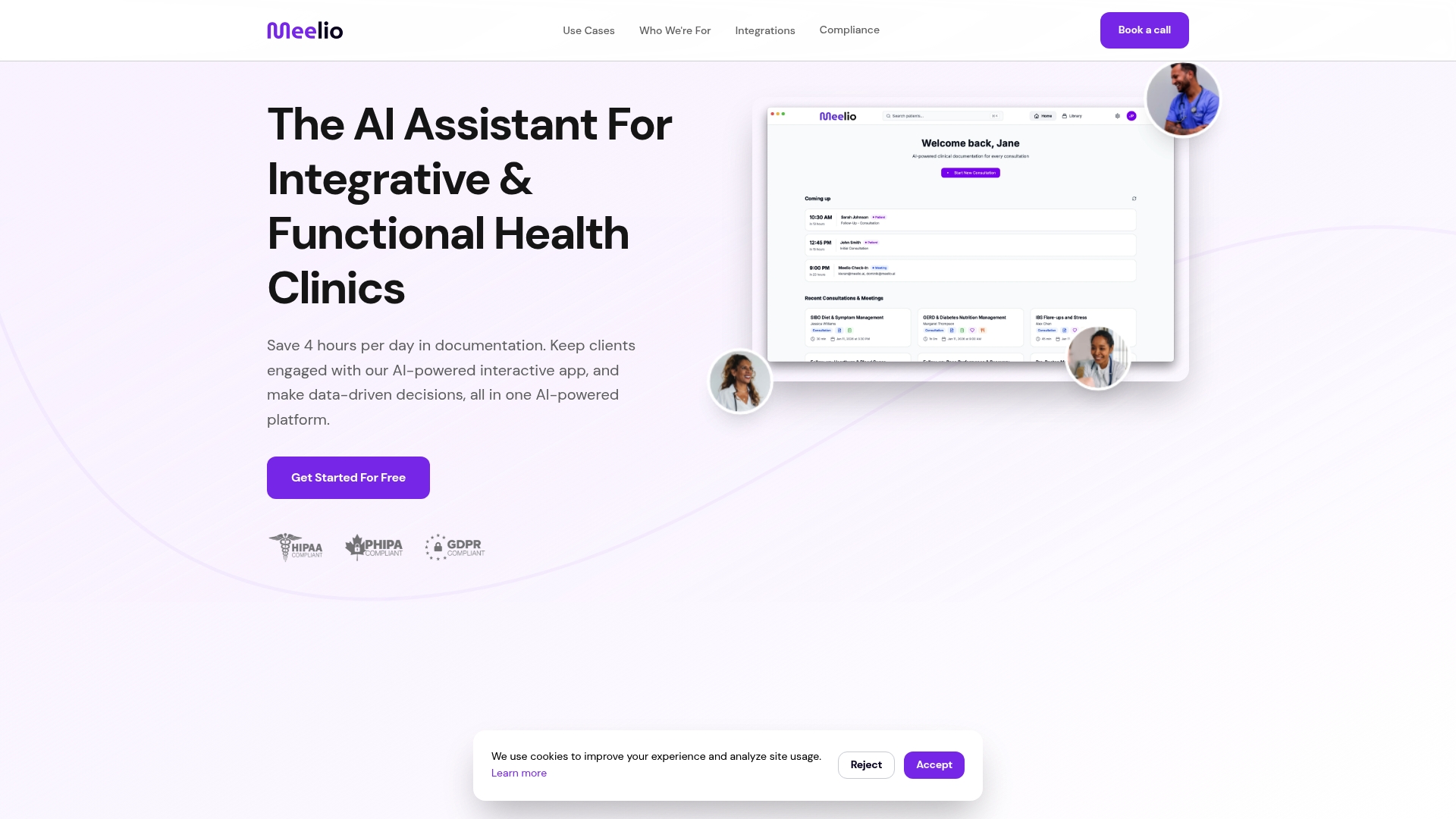
Our system automates care plan generation, personalized nutrition recommendations, meal planning, and longitudinal lab analysis while integrating seamlessly with Practice Better and Cerbo. Practitioners using Meelio report saving 4+ hours daily while improving patient outcomes through more precise protocol application. Explore AI-powered care plans that deliver comprehensive treatment strategies aligned with your chosen frameworks, or discover how our AI assistant supports clinicians in managing complex patient populations efficiently. The platform learns your practice patterns and patient demographics, becoming more valuable over time as it refines recommendations based on your outcomes.
Frequently asked questions about protocol-specific AI
What distinguishes protocol-specific AI from general AI?
Protocol-specific AI trains exclusively on datasets relevant to particular clinical frameworks like Bredesen or Shoemaker, allowing it to recognize patterns and biomarker relationships that general AI overlooks. General AI attempts to serve all medical specialties with broad knowledge, while protocol-specific systems develop deep expertise in the multifactorial relationships central to integrative medicine. This focused training enables more accurate pattern recognition and clinically relevant recommendations for complex cases.
How does it improve patient outcomes in integrative medicine?
Protocol-specific AI improves outcomes by identifying optimal intervention pathways faster, reducing time to effective treatment by approximately 50%. The technology tracks multiple biomarkers simultaneously across body systems, catching subtle deterioration or improvement patterns that manual review might miss. This leads to earlier protocol adjustments when needed and more consistent application of framework principles, resulting in 10-20% higher treatment efficacy compared to standard care approaches.
Is specialized training needed to use protocol-specific AI?
Practitioners need familiarity with the underlying clinical protocols (Bredesen, Shoemaker, etc.) but minimal technical training for the AI itself. Most platforms feature intuitive interfaces designed for clinical workflows rather than requiring programming knowledge. Initial onboarding typically involves 2-4 hours of training on system navigation and recommendation interpretation. The AI complements your existing protocol expertise rather than requiring new clinical competencies.
What are cost implications and ROI for clinics?
Initial costs include licensing fees and implementation time, typically ranging from $300-800 monthly depending on practice size and feature requirements. ROI emerges through multiple channels: 4+ hours daily time savings per practitioner, reduced diagnostic errors, improved patient retention from better outcomes, and decreased costs per patient episode. Most practices achieve positive ROI within 6-12 months, with ongoing benefits compounding as the system learns practice patterns.
Can protocol-specific AI be customized for unique clinical protocols?
Leading platforms allow customization to accommodate practice-specific protocol variations and emerging frameworks. You can typically adjust biomarker thresholds, intervention priorities, and recommendation logic to match your clinical approach. Some systems learn from your feedback over time, automatically refining suggestions based on which recommendations you accept or modify. Discuss customization capabilities with vendors during evaluation to ensure the platform adapts to your methodology rather than forcing standardization.