Lyme Disease Charting in Cerbo EHR: Clinical Guide
Simplify your lyme disease charting cerbo ehr workflow. Use Meelio's protocol-aware ambient AI to push structured Lyme notes directly to Cerbo via API.
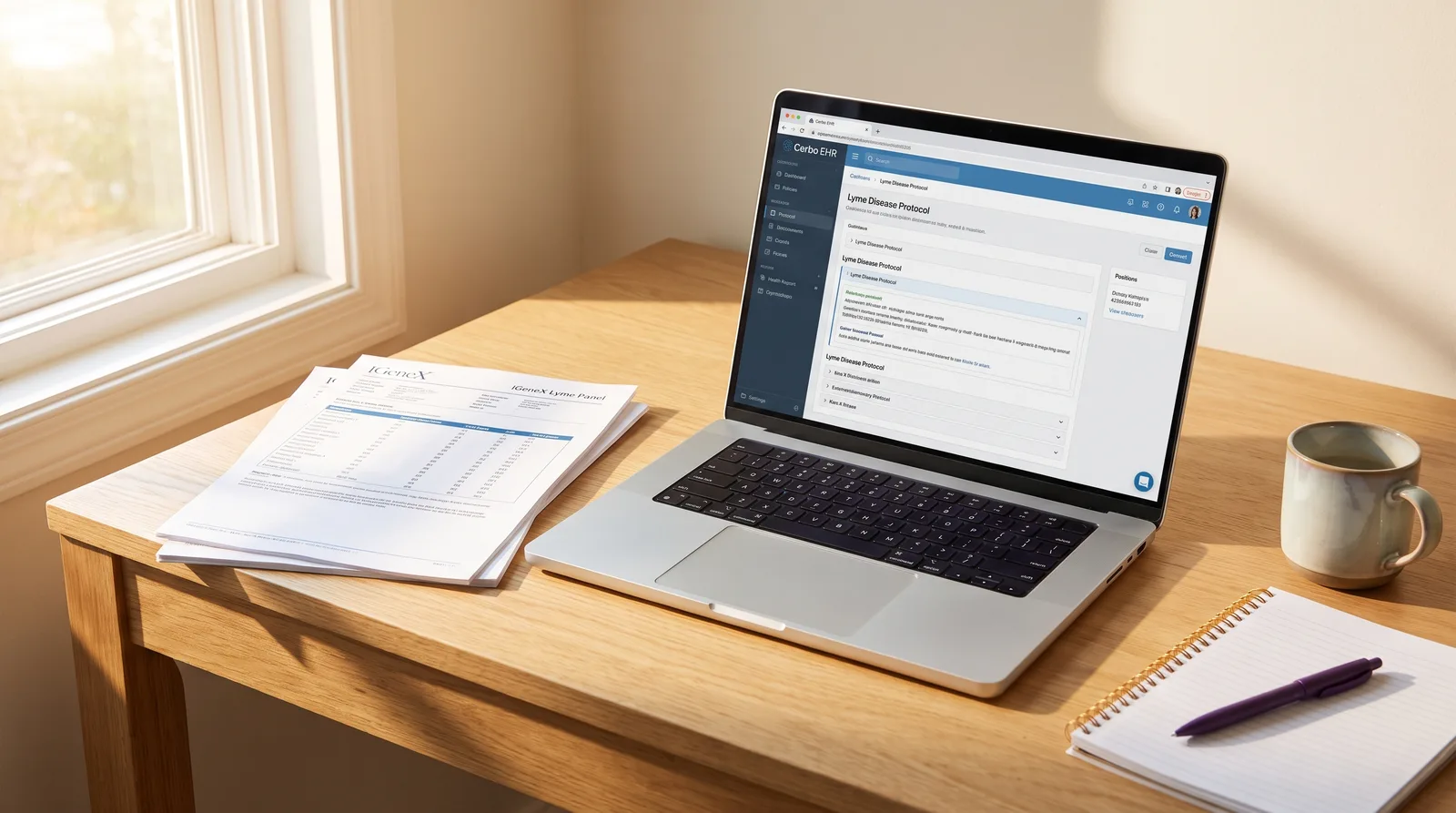
For functional and integrative medicine clinics, optimizing lyme disease charting cerbo ehr workflows is essential to reduce administrative overload and focus on patient recovery. Chronic Lyme disease, tick-borne coinfections, and related multi-system syndromes represent some of the most complex clinical and documentation challenges. Patients presenting with vector-borne illnesses from Borrelia burgdorferi, Babesia, or Bartonella display highly complex symptom profiles that span neurological, musculoskeletal, cardiac, and cognitive systems. Studies show that clinicians spend up to 5.9 hours on electronic health record (EHR) tasks for every 8 hours of scheduled patient time, turning complex patient consultations into overwhelming charting marathons. For practitioners who guide patients through multi-phase botanical and pharmaceutical protocols, adopting a protocol-aware ambient AI scribe is a vital path to saving time and regaining clinical balance.
Rather than forcing providers to spend late hours typing out intricate chronic illness histories, utilizing a dedicated clinical AI assistant automates the heavy lifting of charting. Instead of typing out long biological pathways or manually transferring data between windows, you can engage in natural, story-led conversations with your patients. This guide explores the technical details of documenting complex Lyme protocols, structuring clinical SOAP notes, and pushing completed documents directly into your Cerbo EHR patient records.
Table of Contents
- The Complexity of Lyme Disease Charting in Cerbo EHR
- How Ambient AI Scribes Automate Lyme and Coinfection Note Drafts
- Pushing Structured Lyme Notes to Cerbo EHR via API
- Documenting Phased Lyme Protocols and Care Plans
- Meelio vs. Generic Scribes vs. Manual Charting
- Clinical Accuracy and Grounding in Complex Charting
- Frequently Asked Questions
Key Takeaways
| Charting Metric or Aspect | Manual Charting or Generic AI Scribes | Meelio Scribe + Cerbo EHR Integration |
|---|---|---|
| Documentation Speed | Requires up to 45 minutes of manual clinical note drafting per complex patient encounter | Reduces documentation time to under 3 minutes per encounter by capturing dialogue in real time |
| Protocol Recognition | Fails to recognize specialized herbal or pharmaceutical Lyme protocols, requiring manual corrections | Natively recognizes complex regimens (Buhner, Cowden, Byron White, dapsone, disulfiram) |
| EHR Integration | Requires manual copy-pasting of notes or template creation, increasing friction | Uses a secure API to push structured SOAP notes directly into the Cerbo patient encounter |
| Artifact Generation | Only drafts standard clinical notes; cannot generate patient-friendly care plans or meal designs | Automatically generates clinical notes, custom PDF care plans, and personalized nutrition plans |
The Complexity of Lyme Disease Charting in Cerbo EHR
Lyme disease is rarely a straightforward diagnosis. Most patients present with a mix of coinfections (such as Babesia microti, Bartonella henselae, and Anaplasma phagocytophilum) along with secondary complications like Mast Cell Activation Syndrome (MCAS) or Chronic Inflammatory Response Syndrome (CIRS). Practitioners must track a vast array of diagnostic markers, including IGeneX immunoblot panels, ArminLabs EliSpot testing, or Vibrant Wellness Tickborne panels.
When documenting a single Lyme consultation, a practitioner must capture:
- Multi-System Symptom Tracking: Migratory joint pain, cognitive "brain fog," autonomic dysregulation, dermatological rashes (such as erythema migrans or Bartonella striae), and sleep disturbances.
- Diagnostic Lab Interpretation: Tracking specific antibody bands (e.g., 23 kDa, 31 kDa, 34 kDa, 39 kDa, 41 kDa, 93 kDa) and inflammatory biomarkers (like TGF-beta1, C4a, and MMP-9) according to standard ILADS guidelines.
- Phased Therapeutic Protocols: Managing multi-phase regimens that alternate between cell-wall agents (like amoxicillin or cefuroxime), persister drug protocols (like dapsone or disulfiram), and targeted botanicals (including Japanese Knotweed, Cat's Claw, and Sweet Wormwood).
- Herxheimer Reaction Tracking: Documenting patient tolerance, detoxification drainage support, and cytokine-lowering strategies.
In Cerbo EHR, managing this level of detail usually requires building dozens of complex "Chart Parts" (Cerbo's macro system) and typing extensive free-text notes. Because these consultations are highly narrative and exploratory, traditional dictation tools fail. They cannot keep up with the rapid, conversational exchanges between a practitioner and a patient discussing binder schedules or herbal drop increments.
How Ambient AI Scribes Automate Lyme and Coinfection Note Drafts
An ambient AI scribe like Meelio works by listening to the natural conversation in the room (or via virtual telehealth consults). Instead of forcing you to stare at a screen and check boxes while the patient shares their history, Meelio captures the raw audio and processes it using clinical-grade, protocol-aware language models.
During a complex tick-borne disease visit, the discussion might jump from the patient's reaction to disulfiram, to their current dose of Byron White herbal drops, to their sleep hygiene. Meelio's AI does not just transcribe these words: it understands their clinical significance. The system identifies:
- Clinical Entities: It recognizes specialized diagnostic and therapeutic terms such as Buhner protocol, Cowden support, RealTime Labs, Vibrant Wellness, or IGeneX testing.
- Dosing Regimens: It captures when a patient mentions they are taking "two drops of Byron White A-L twice daily, increasing by one drop every three days."
- Symptom Clustered Structure: It separates joint pain under musculoskeletal systems and brain fog under neurological systems, organizing them into a professional clinical format.
By automating the synthesis of these details, Meelio helps clinicians save hours on documentation. You can read more about how ambient clinical AI reduces practitioner fatigue in our guide to functional medicine charting in Cerbo EHR.
Pushing Structured Lyme Notes to Cerbo EHR via API
While many generic AI scribes draft a note and leave you to copy and paste it into your EHR, Meelio features a full bi-directional integration with Cerbo EHR. This integration allows you to push finalized clinical notes directly into the patient's record with a single click.
+-----------------------------------+
|       Meelio Desktop App          |
|  - Captures Audio & Transcribes   |
|  - Generates Structured SOAP Note  |
|  - Creates PDF Care & Meal Plans  |
+-----------------+-----------------+
                  |
                  | (Secure API Push)
                  v
+-----------------+-----------------+
|           Cerbo EHR               |
|  - Creates New Encounter Note      |
|  - Attaches PDFs to Patient Chart |
|  - Adds to Provider Review Queue  |
+-----------------------------------+
Once Meelio generates your structured clinical note, you can review and edit it within the Meelio desktop app. When you are satisfied, click the Sync to Cerbo button (indicated by the up-right arrow icon) to open the sync dialog:
- Create or Update Encounter: You can send the note as a brand-new electronic encounter note inside Cerbo, selecting the date of service and the encounter type (such as Office Visit or Functional Consult). Alternatively, you can choose to append the note to an existing unsigned encounter.
- Attach as PDF: For complex supplement plans or patient care guides, you can render them into beautiful PDFs and attach them directly to the patient's chart. Meelio automatically generates clean chart document names that omit redundant dates and patient names (e.g., "Lyme Treatment Protocol") and caps them at 255 characters to ensure compatibility.
- Review Queue Routing: You can check the box to route the PDF directly to your Cerbo review queue for formal sign-off, or file it directly into the patient's chart history.
This level of integration is unique to Cerbo EHR. For other platforms like Practice Better, Meelio provides advanced one-click clipboard copying helpers to move nutrition and care plans. You can read about nutritional integration features in our guide to personalized nutrition platforms.
Documenting Phased Lyme Protocols and Care Plans
Treating chronic vector-borne illness requires highly detailed, phased protocols. A patient might start with microbial support, transition to cell-wall therapeutics, and eventually move into heavy metals detoxification or mold binder protocols. Keeping these phases organized in clinical charts is vital for tracking patient outcomes over time.
For example, when a practitioner discusses transitioning a patient to a persister-cell Lyme protocol utilizing disulfiram or double-dose dapsone, the documentation must reflect:
- Baseline Labs: Documenting liver function tests (LFTs) and complete blood counts (CBC) to monitor for drug-induced hemolysis or elevated liver enzymes according to standard CDC Lyme guidelines.
- Herxheimer Mitigation: Clear instructions for binder protocols (like Cholestyramine, bentonite clay, or activated charcoal) taken at least two hours away from food and medications.
- Cofactors: Specific supportive agents like liposomal glutathione, alpha-lipoic acid (ALA), and targeted trace minerals.
With Meelio, these complex, multi-phase care plans are automatically drafted alongside your clinical SOAP note. The AI separates the practitioner-facing clinical note from the patient-facing care instructions. This ensures that the patient receives a clear, easy-to-read protocol showing when to take their supplements and binders, while your Cerbo encounter note remains highly technical and billing-compliant.
To learn more about how protocol-aware AI simplifies other complex testing workflows, check out our clinical guides on DUTCH test charting in Cerbo EHR and GI-MAP test charting in Cerbo EHR.
Meelio vs. Generic Scribes vs. Manual Charting
Generic AI scribes are built on general-purpose language models trained on standard hospital documentation. While they might understand a basic cold or flu visit, they are completely lost when a functional medicine doctor begins discussing the Shoemaker CIRS protocol, HLA-DR genetics, biotoxin pathways, or botanical protocols.
When a generic scribe encounters words like "Cryptolepis sanguinolenta," "Houttuynia cordata," "Banderol," or "Alinia," it often hallucinates or misinterprets them as gibberish, requiring extensive manual editing. In contrast, Meelio's "Practice DNA" library allows clinics to upload their unique protocol templates, clinical preferences, and vocabularies. This ensures that the generated notes match your exact clinical voice and style from day one.
Additionally, surveys show that healthcare documentation overhead is a primary driver of professional dissatisfaction, with physicians spending substantial portions of their day on administrative work rather than direct patient interaction. By deploying an EHR-integrated assistant, you can recapture valuable time and eliminate the stressful "pajama time" spent charting at night.
For a deeper dive into how Meelio compares to general automation solutions, read our guide on why to use protocol-specific AI in integrative health.
Clinical Accuracy and Grounding in Complex Charting
In complex chronic illness care, accuracy is everything. A misspelled medication name, an incorrect supplement dose, or a misplaced lab value can compromise patient safety. Meelio addresses this by using a strict grounding architecture that anchors the clinical AI to verified medical facts and your specific practice templates.
It is important to remember that Meelio is an assistant designed to draft documentation: the clinician always reviews, edits, and finalizes the note. Our platform does not make clinical decisions, diagnose patients, or prescribe treatments. Instead, it serves as a highly skilled medical scribe, capturing the nuances of your clinical reasoning and structuring them into notes that reflect the high standard of your practice.
By combining clinical-grade speech recognition, deep protocol awareness, and secure, direct API integration with Cerbo EHR, Meelio enables practitioners to focus on what matters most: helping patients recover from complex chronic illnesses.
Frequently Asked Questions
How does Meelio handle specialized Lyme testing like IGeneX or ArminLabs?
Meelio is protocol-aware and recognizes specialized tick-borne disease diagnostic testing. When you discuss immunoblot bands, EliSpot results, or PCR markers with your patient during a consultation, Meelio accurately captures these biomarkers and organizes them into the Objective section of your clinical SOAP note, eliminating the need to manually type out lab results.
Can Meelio push notes directly to Cerbo EHR?
Yes. Meelio features a full bi-directional integration with Cerbo EHR via secure API. Clinicians can review the generated clinical notes in the Meelio desktop app and push them directly as new encounter notes or append them to existing encounters inside the patient's Cerbo chart.
How does Meelio recognize specialized herbal and botanical protocols?
Meelio is trained on integrative and functional medicine vocabularies. It natively understands complex botanical protocols (such as Buhner, Cowden, Byron White, and Zhang) and specialized herbal ingredients (like Cryptolepis, Houttuynia, Cat's Claw, and Japanese Knotweed), ensuring high accuracy in clinical drafts.
Is Meelio compliant with HIPAA regulations?
Yes. Meelio is fully HIPAA-compliant. We utilize enterprise-grade encryption (AES-256) for data at rest and TLS 1.3 for data in transit. We sign Business Associate Agreements (BAAs) with all practices, ensuring that patient data remains secure, private, and fully protected.